
ELECTRICAL & ELECTRONICS ENGINEERING LABORATORIES
The Department is well equipped for teaching and is continually upgrading its laboratories to expose the students to the latest equipment in Electrical & Electronics Engineering. The Students are also allowed to use laboratories for their project work.
Currently there are four laboratories in the department.
Basic Electrical Lab
Lab In charge: Mrs. Sithal R. Fal Dessai (Lecturer in Electronics Engg.)
Lab objective:
- Objective of basic laboratory is to expose students to the practical executions of the fundamental theories of Electrical Engineering.
- Practical’s in the following subjects are conducted in the basic electrical lab
- Basic engineering (Electrical) Practice.
- Electrical & Electronics workshop.
- Electrical measurements and instruments.
- Substation practice.
List of equipment’s:
- Over current Electro Mechanical Relay Trainer
- Differential Relay Testing system
- Meter Demonstrator
- MCB & HRC Fuse Testing
- Transformer Oil Testing Kit
- Earth Fault Relay
- Wire Wound Rheostat
- Star Delta Starter
- DOL Starter
- Insulation Tester
- 3 phase Motor Trainer Kit
- Motor Generator Set
- DC Motor Trainer Kit
- Transformer Trainer Assembly Cut View
- Current Transformer Ring Type
- Auxiliary Transformer
- 3 Phase Loading Rheostat
- 3 Phase Auto Transformer
List of experiments /skill developed:
- Recognize the tools of the trade and the materials (electrical components).
- Handle tools and materials (pick, move and set down) and to handle objects without damage to either the object or other objects in its environment or hazard to any person.
- Perform the elementary, specific detail tasks such as to hold the tool appropriately for use, to set the tool in action.
- Repair and maintenance of different electrical equipment’s such as mixer, fan, power supply etc.
- Estimate the material required for house wiring.
Operate various meters/ instruments and interpret the measurement.
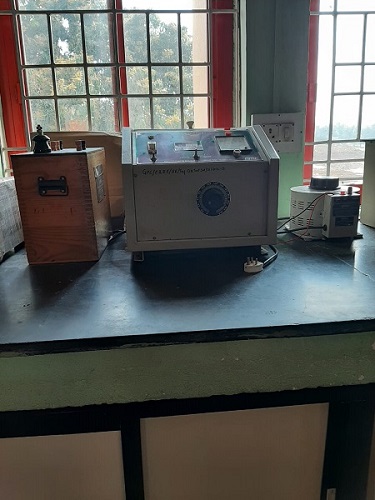
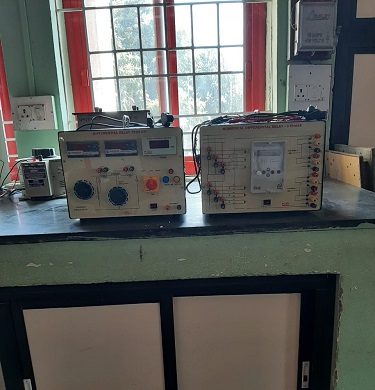
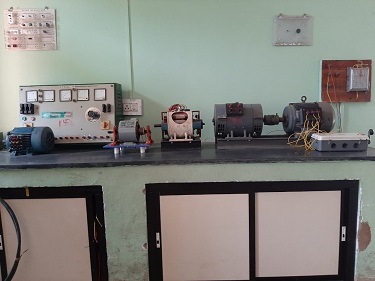
Electrical Machines lab
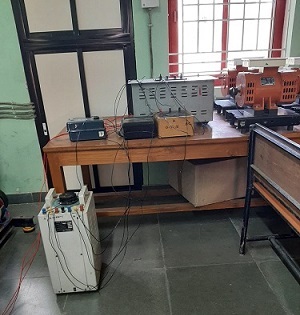
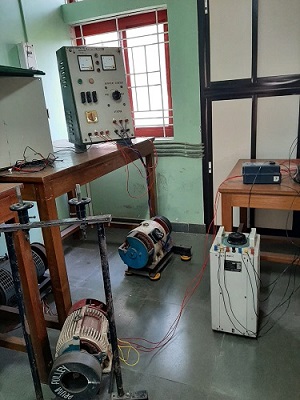
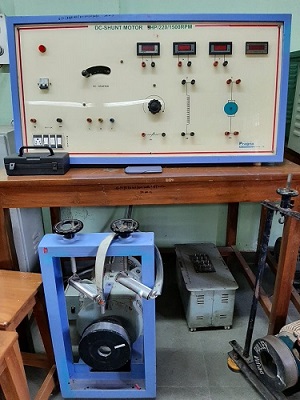
Lab In charge: Mrs. Siddhi S. Pai alias Siddhi R. Talwadker (Lecturer in Electrical Engg)
Lab objective:
- To impart hands on experience on Electrical machines like DC machines, synchronous motors, transformer and induction machines.
- Practical’s in the following subjects are conducted in the Electrical Machines lab
- Electrical Machines I
- Electrical Machines II
- Electrical Drives
List of equipment’s:
- DC shunt Motor
- Pole changing Induction Motor
- Squirrel Cage Induction Motor
- Squirrel cage Single phase Induction Motor
- Synchronous Three Phase Motor
- Schrage Commutator Motor
- DC compound Motor Coupled to DC Generation
- Master Unit & Electrical Machine Trainer
- Three Phase Transformer
- Single phase Transformer.
- Alternator panel
List of experiments /skill developed:
- OCC, no-load test, load test on dc generators
- No-load test, load test and speed control methods on dc motors
- Open circuit, short circuit and parallel operation on transformers
- Blocked rotor, no-load and load tests on three phase induction motors
- Open Circuit, Short Circuit and slip tests on synchronous machines to determine their performance characteristics
- Dynamic braking of DC motor
- Plugging of induction motors, Speed control of induction motors.
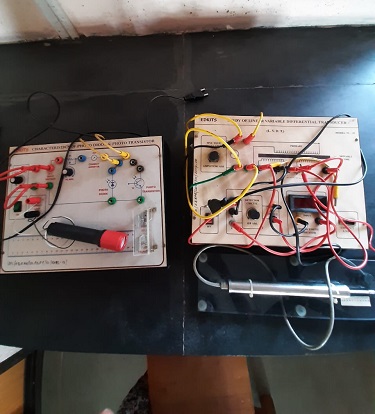
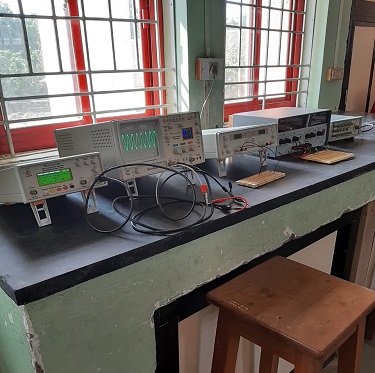
Applied Electronics Lab
Lab Incharge: Mrs. Zindia K Raikar (Lecturer in Electronics Engg)
Lab Objective:
- Understand the principles and working of basic electronic components, devices and instruments.
- Apply theoretical framework in practice for subjects such as Circuits and Networks, Introduction to Microcontrollers, Electronic Instrumentation, Applied and Integrated Electronics, Elements of Communication Systems.
List of Equipments:
- Cathode Ray Ocilloscope-
- Regulated DC Power Supply-
- Function Generator-
- Function Generator Trainer
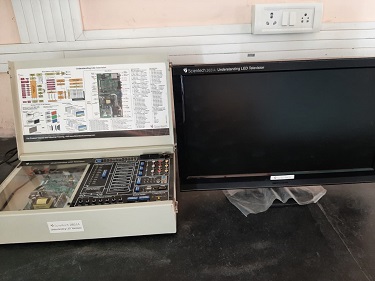
- Colour TV trainer Kit
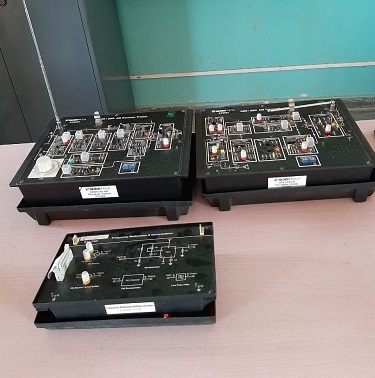
- Frequency/ Amplitude Modulation kits
- DSB/SSB AM Receiver Trainer
- DSB/SSB AM transmitter Trainer
- Power Electronics Kits
- Multimeters
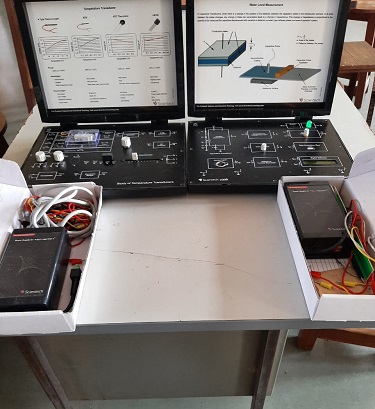
- Electronic Instrumentation kits such as RTD, Thermocouple, LVDT, Strain Gauge, Thermisters, Piezo Electric Transducer, Characteristics of Photo Diode and Photo Transistors, Potentiometer as Displacement Transducer
- Circuits & Networks Kits-Thevenin Theorem, Norton theorem, Superposition, Kirchoff’s Law, Ohms Law, series Resonance, Constant K type filter, High pass & Low pas filter.
List of experiments/skill developed:
- Verification of basic network laws and theorems
- Study of RLC series resonance circuits
- Study of RC Integrator and RC Differentiator
- Study of filters LPF & HPF, T & PI Type
- Verification of rectifiers, Zener diode regulators, transistor biasing circuits, Op-amp based applications
- Executing basic assembly level programs on 8051 micro controller kit.
- Interfacing 8051 with peripherals such as LED’s, 7 segment display, ADC/DAC.
- Verify working of transducers such as resistive, inductive, Capacitive, LVDT, strain gauge, photo-transducers, thermo-transducers.
- Study of modulation and demodulation techniques on trainer kits.
- Identification of faults in different sections of TV transmitter.
Digital electronics Lab
Lab In charge: Mr. Vaibhav V. Velip (Lecturer in Electronics Engg)
Lab objective:
- Objective of digital laboratory is to acquire basic knowledge of digital logic levels and applications. It provides the platform for multidisciplinary design and projects.
- It also aims to impart practical knowledge of Power semiconductor devices and power electronics circuits.
- Practical’s in the following subjects are conducted in the digital electronics lab
- Digital Electronics.
- VLSI design.
- Power Electronics & Drive Control.
- Industrial Automation.
- Electrical Drawing using CAD
List of Equipments
- 16-bit Digital Kits
- Power Electronic Kits
- Characteristics of DIODE, TRIAC, DIAC, SCR Kits
- IGBT Characteristics Kit
- SCR full wave & Half wave Controlled Rectifier Kits
- 4-bit up/down Counter Kit
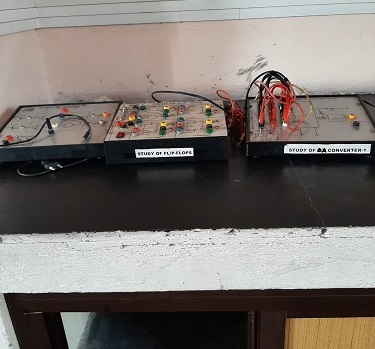
- JK, RS, Flip Flop Kits
- D/A converter Kit
- Encoder & Decoder Kits
- Microcontroller Trainer Kits
- PLC Trainer Kits
List of experiments/skill developed:
- Verification of Logic gates and Demorgan’s Theorems
- Study of basic combinational circuits using logic gates.
- Study of basic Sequential circuits
- Study characteristics of Power electronics devices
- Study power electronics circuits such as inverter, cycloconverter, AC voltage controllers, etc.
- Write and verify ladder programs for basic applications.
Verify ladder program for PLC based applications such as conveyor system, elevator system, bottle filling etc.